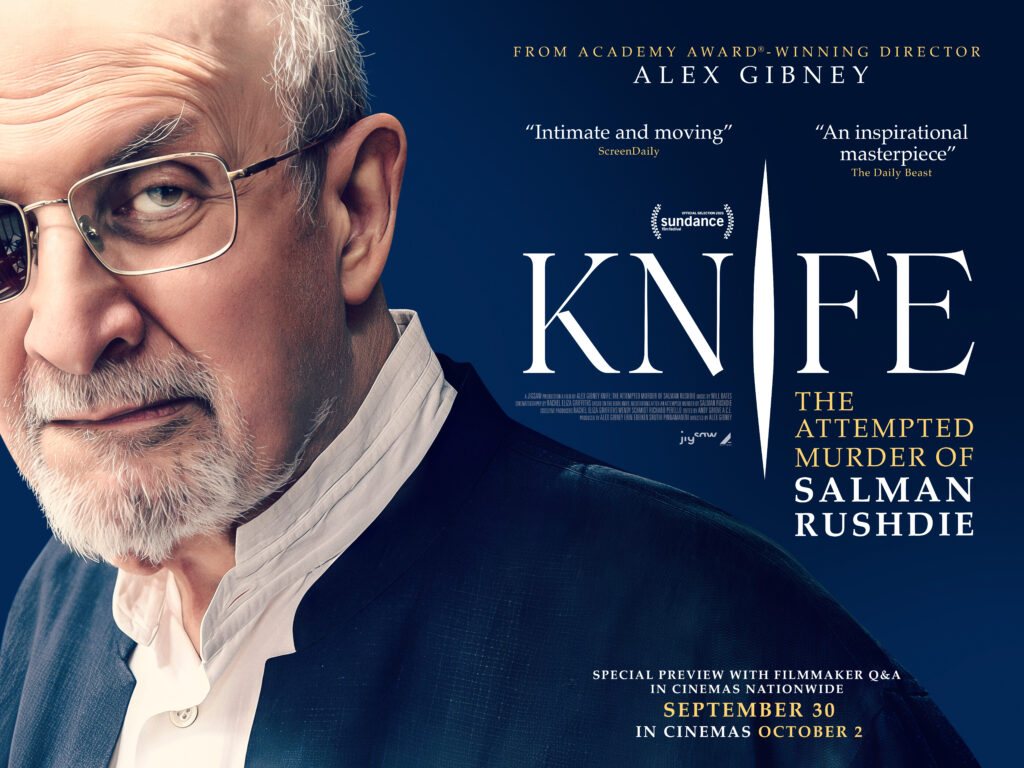

I’ll be completely honest: before watching KNIFE: The Attempted Murder of Salman Rushdie, I knew the name Salman Rushdie far better than I knew the man. I remembered hearing his name constantly on the news while growing up. I knew he was an author. I knew he was controversial.
What I hadn’t fully understood was why.
Alex Gibney’s documentary changed that.
Synopsis
New footage by Rushdie’s wife shows his recovery path after the attack, capturing both physical healing and renewed hope. Based on his memoir “Knife: Meditations After an Attempted Murder.”
The Trailer…
My Thoughts
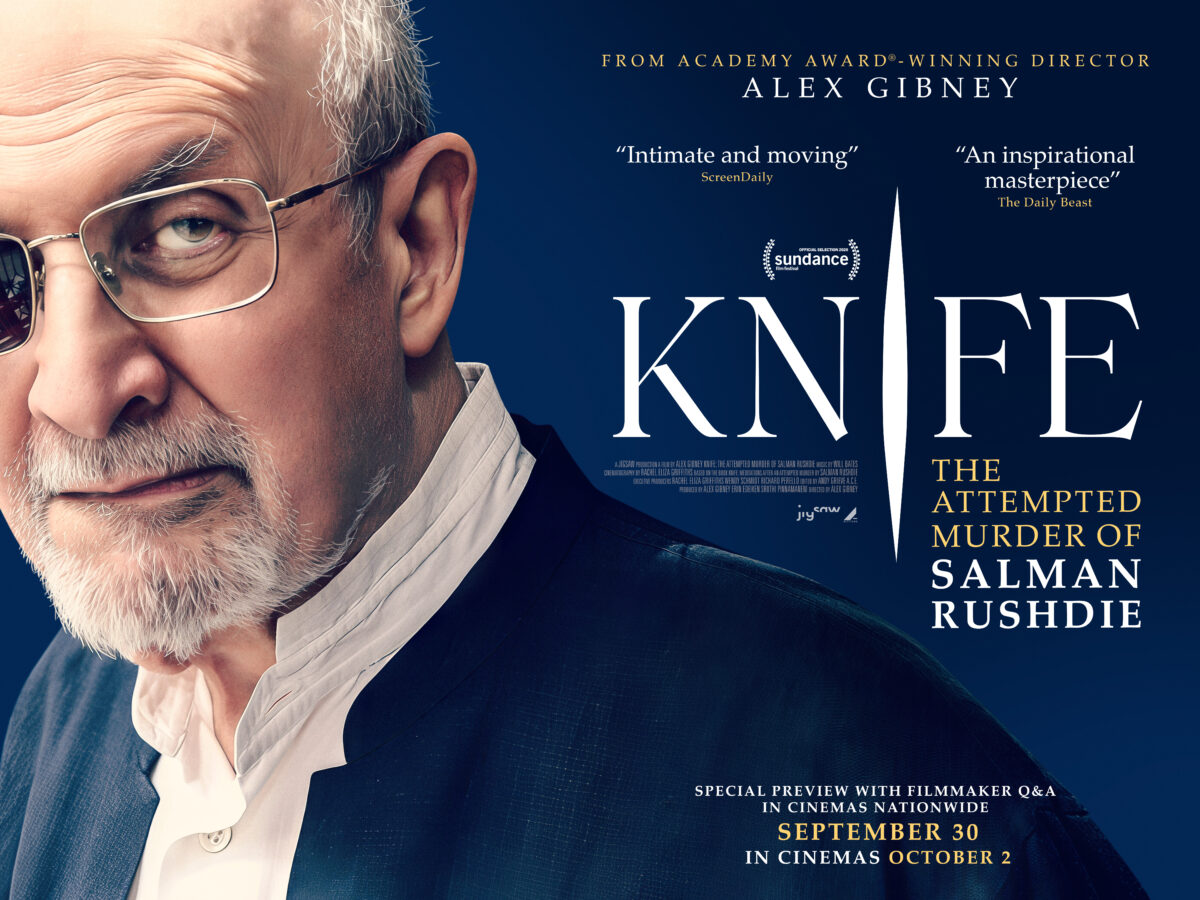
Inspired by Rushdie’s memoir Knife: Meditations After an Attempted Murder, the film takes us back through the extraordinary events surrounding the publication of The Satanic Verses, the outrage the book provoked and the 1989 fatwa issued against him by Iran’s Ayatollah Khomeini.
Suddenly, those old news reports I vaguely remembered had context.
Rushdie wasn’t simply a controversial writer appearing on television. He was a man forced into hiding, living with security and the knowledge that people genuinely wanted him dead because of something he had written.
And yet eventually he chose to live openly again.
That was one of the things I found most extraordinary about him.
At some point, hiding indefinitely behind security guards stopped feeling like a life. Rushdie began returning to public events, travelling and refusing to allow fear to completely dictate how he existed.
Then, in August 2022, the threat everyone hoped belonged to the past suddenly became horrifyingly real.
While appearing onstage at New York’s Chautauqua Institution, Rushdie was attacked and repeatedly stabbed before he could even begin the talk he was there to give.
The documentary doesn’t shy away from what followed.
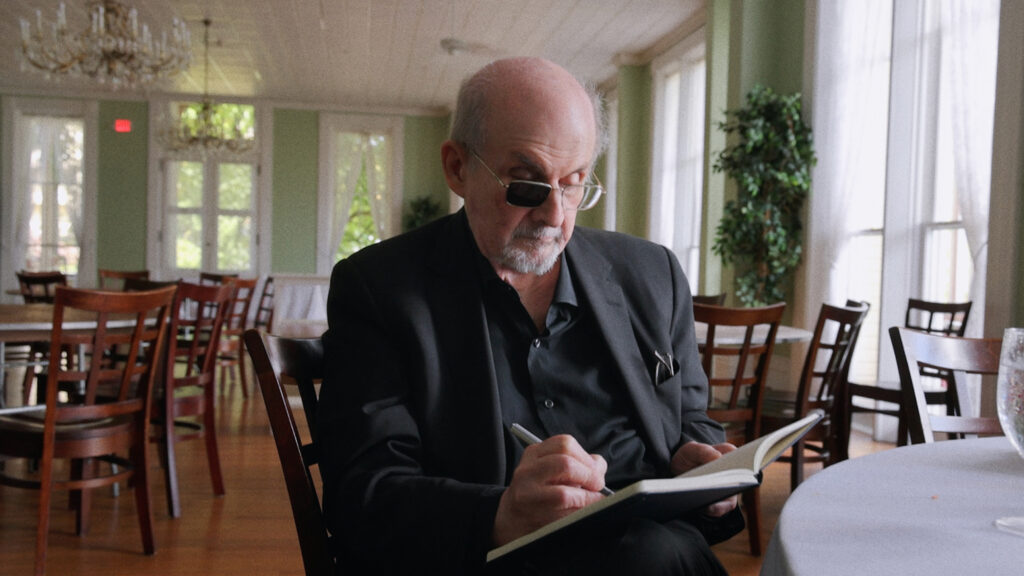
There are some incredibly difficult images, including intimate footage filmed by his wife, poet and visual artist Rachel Eliza Griffiths, throughout his recovery.
But rather than feeling voyeuristic, those scenes ultimately become a remarkable record of survival.
You watch a badly injured man slowly reclaim his body, his voice, his humour and his life.
And throughout it all, Rushdie remains unmistakably a writer.
He certainly speaks like one and thinks like one.
Even the way he processes the man who attacked him, whom he frequently reduces simply to “A” becomes an act of imagination and storytelling.
One detail particularly stayed with me: his attacker hadn’t even been born when the controversy surrounding The Satanic Verses began.
That is chilling.
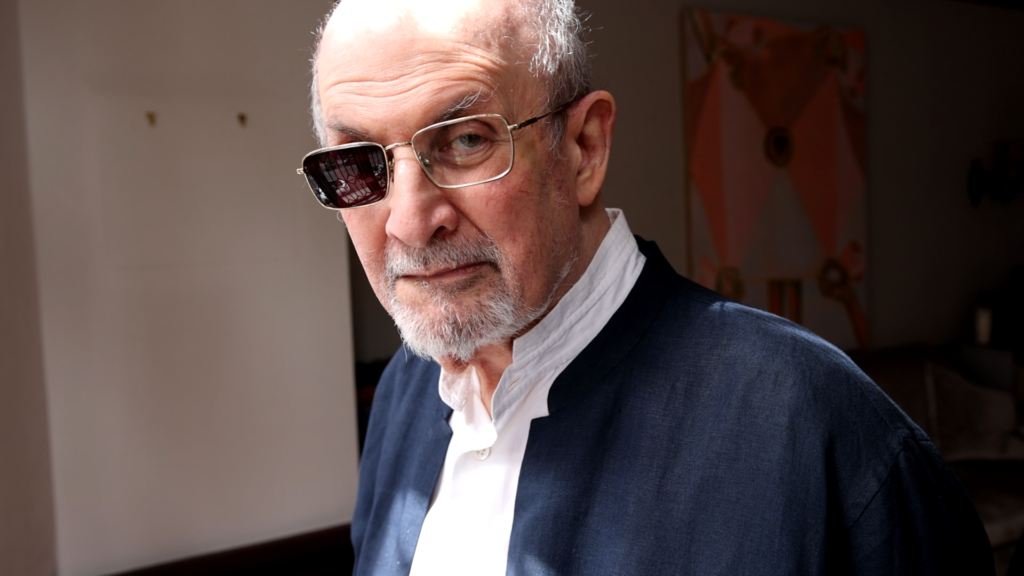
It shows how anger, ideology and hatred can survive far beyond the original moment that created them, passed from one generation to another.
But KNIFE isn’t ultimately a documentary about hatred.
For me, it became a documentary about the will to live.
Salman Rushdie’s recovery is extraordinary, but so is his refusal to let the attack become the only thing that defines him.
The film also raises a much larger question about freedom of expression.
How far should artistic freedom extend when somebody else’s beliefs are deeply offended?
And does offence ever justify trying to silence imagination?
Rushdie’s position is clear: writers must be allowed to imagine. That doesn’t mean everybody has to like what they imagine. It doesn’t mean nobody will be offended.
But a world in which imagination itself has to operate within boundaries imposed by fear is a very different kind of world.
What also struck me was the impact on the people around him.
His wives, his children and particularly his family had to live with consequences created by threats they had no control over. That human cost sometimes gets lost when someone becomes a symbol rather than a person.
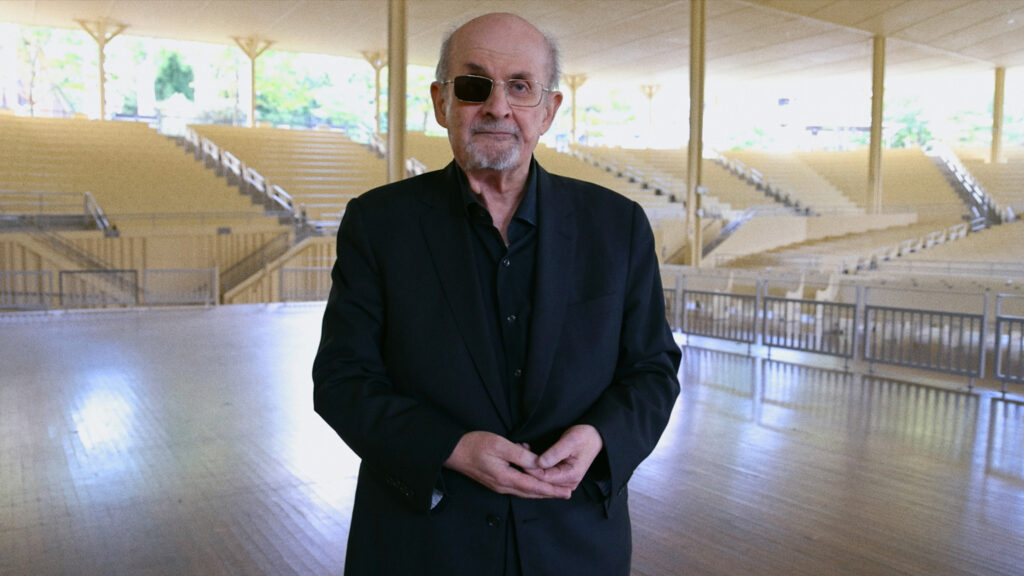
KNIFE restores the person.
Salman Rushdie becomes more than a headline, more than a controversial author and more than the man who survived an assassination attempt.
He’s funny.
He’s imaginative.
He’s stubborn.
He’s vulnerable.
And above all, he is incredibly brave.
KNIFE: The Attempted Murder of Salman Rushdie is shocking, emotional and incredibly enlightening but ultimately, I found it hopeful.
Because underneath the politics, controversy and violence is something incredibly simple:
The human desire to live, to love, to create and to refuse to let somebody else’s hatred decide the limits of your life.
Harrowing, enlightening and deeply inspiring. A remarkable portrait of survival, imagination and one man’s refusal to live in fear.
In UK Cinemas Friday 2nd October 2026 in UK Cinemas Nationwide
Thanks for reading!
Chanel x
Chanel Williams